
Carbon Footprint Verification
View this service

The Corporate Sustainability Reporting Directive (CSRD) represents the EU’s most ambitious and comprehensive sustainability reporting framework to date, superseding the Non-Financial Reporting Directive (NFRD) from January 2024. As a leading emissions verification body, we recognize the adoption of CSRD as a key moment in corporate environmental accountability, fundamentally transforming how companies report and verify their environmental, social and governance practices.
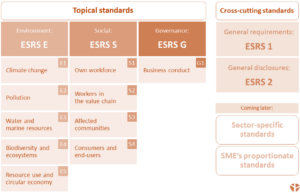
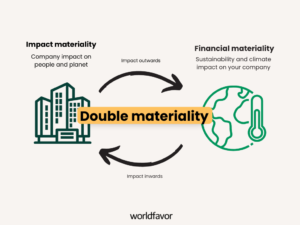
The CSRD is a mandatory reporting framework that standardises corporate ESG disclosure in the EU. At its core, the directive introduces the European Sustainability Reporting Standards (ESRS), which consist of 12 comprehensive standards: 2 cross-cutting standards that define key reporting principles, and 10 topical standards focusing on specific environmental (5), social (4), and governance issues (1). Companies must now conduct thorough double materiality assessments which entails examining both their impact on sustainability matters and how sustainability issues affect their business. The reporting requirements encompass detailed emissions data across all scopes, including scope 3 emissions which cover the entire value chain. Organizations must develop and disclose transition plans aligned with the Paris Agreement, demonstrating their pathway to climate neutrality. The directive also mandates comprehensive environmental impact assessments, rigorous supply chain due diligence, and detailed analysis of impacts on biodiversity and ecosystems.
The CSRD was adopted in April 2021. In December 2022, the ESRSs were finalized to outline specific reporting categories. Member states have 18 months to incorporate the directive into national law. Starting in 2024, companies already subject to NFRD, approximately 11,700 organizations, will begin reporting under the new framework. The scope expands significantly in 2025 to include large companies not previously subject to NFRD, bringing the total to around 49,000 companies. By 2026, listed SMEs, small and non-complex credit institutions, and captive insurance companies will join the reporting regime. The final phase in 2028 extends to non-EU companies with substantial EU operations, specifically those generating over €150 million in EU turnover.
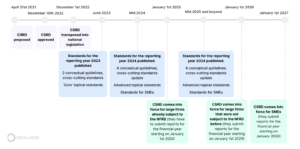
Source: Circularise
The CSRD is necessitated by the urgent need for transparency and accountability in corporate sustainability practices. As climate change becomes an increasingly pressing global issue, investors, consumers, and regulatory bodies are demanding clear and reliable information about companies’ sustainability impacts. The CSRD seeks to address the growing demand for quality sustainability data, standard format for reporting of ESG KPIs, thereby fostering informed decision-making and promoting sustainable business practices.
The Corporate Sustainability Reporting Directive (CSRD) applies to a wider range of entities, including foundations, trusts, and franchises. Specifically, it mandates reporting for:
Businesses that meet at least two of these criteria:
The deadline for compliance varies based on current reporting obligations:
This includes companies based both inside and outside of the EU. Non-EU companies with a turnover of over €150 million in the EU will also be required to comply.
Companies whose financial assets are traded on EU markets. They must comply starting from fiscal years beginning on or after January 1, 2026.
While non-listed SMEs and micro-enterprises are exempt from mandatory CSRD reporting, they can voluntarily choose to adhere to the standards.
The CSRD will impact a broad range of sectors, including but not limited to:
The manufacturing sector confronts unique challenges in measuring and reporting supply chain emissions, documenting resource consumption patterns, and implementing verifiable waste management protocols. This sector’s reporting requirements extend deep into their value chains, necessitating unprecedented levels of supplier engagement and data collection.
The energy and utilities sector faces perhaps the most significant transformation under CSRD. These companies must provide exhaustive emissions reporting across their operations, develop comprehensive transition plans, and set concrete renewable energy targets. The complexity of their operations requires sophisticated monitoring and verification systems.
Financial services institutions must now account for their investment portfolio emissions, conduct detailed climate risk assessments, and align their disclosures with sustainable finance regulations. This represents a fundamental shift in how financial institutions evaluate and report their environmental impact.
The real estate sector must report comprehensively on building energy performance, construction materials’ environmental impact, and long-term renovation strategies aligned with EU climate goals. This includes detailed assessments of both operational and embodied carbon.
The transportation sector faces stringent requirements around fleet emissions reporting, infrastructure adaptation planning, and modal shift strategies. Companies must demonstrate how they’re transitioning to low-carbon transportation solutions while maintaining operational efficiency.
The CSRD introduces mandatory independent third-party assurance of sustainability reporting, marking a significant advancement in reporting credibility. Initially, companies must obtain limited assurance on their sustainability reports, with a planned transition to reasonable assurance by 2028. This graduated approach allows both companies and verification bodies to develop robust systems and expertise.
The verification scope encompasses comprehensive compliance with ESRS, requiring assurance providers to validate not only data accuracy and completeness but also assess the effectiveness of reporting processes and controls. Verification bodies will evaluate companies’ double materiality assessments, ensuring proper identification and reporting of material sustainability impacts.
The directive sets high standards for verifier competency. Verification bodies are required to maintain appropriate accreditation, demonstrate specialized sustainability expertise, and possess thorough technical knowledge of ESRS. This has prompted a significant industry-wide upskilling initiative among assurance providers.
The CSRD is part of the EU’s broader commitment to achieving climate neutrality by 2050, as outlined in the European Green Deal. By enforcing stricter reporting requirements, the directive aims to drive investment towards sustainable projects and facilitate the transition to a low-carbon economy. Furthermore, it aligns with global initiatives such as the Paris Agreement, reinforcing the EU’s leadership in international climate policy.
The CSRD represents a leap forward from its predecessor, the NFRD. The scope expansion from 11,700 to over 50,000 companies fundamentally changes the EU’s sustainability reporting landscape. The introduction of mandatory assurance requirements adds a crucial layer of credibility to sustainability reporting. Digital tagging requirements ensure machine readability, facilitating data analysis and comparison. The granularity of environmental metrics has increased substantially, requiring companies to report on a broader range of sustainability indicators with greater precision. Forward-looking disclosure requirements push companies to develop and communicate clear sustainability strategies and transition plans.
The mandate for value chain assessment extends company responsibility beyond direct operations to their entire sphere of influence. As emission verification becomes a cornerstone of compliance, companies must prioritize accurate reporting and responsible practices to align with the evolving regulatory landscape. The future is clear: sustainability is not just an option; it is a business imperative.