
ReFuelEU Aviation
View this service

ReFuelEU Aviation (Regulation (EU) 2023/2405) is one of the European Union’s key measures to reduce aviation emissions by increasing the use of sustainable aviation fuels and discouraging economic tankering. For aircraft operators, Article 5(1) requires that at least 90% of the yearly aviation fuel required for flights departing from a Union airport is uplifted from that Union airport. Where this threshold is not met, Article 5(2) is used for justification, and EASA’s guidance and Monitoring Tool support the monitoring and reporting process. The 2025 reporting year is also the first in which competent authorities can impose penalties for non-compliance with Article 5(1) of the ReFuelEU Aviation Regulation 2023/2405.
In 2024, the first reporting year, the main challenge was establishing the monitoring and reporting process itself. In 2025, the picture is more developed. The question is no longer only whether operators are reporting, but what the reports show about compliance behaviour and justification quality. That is where this year’s verified information becomes useful.
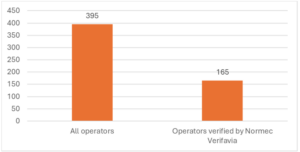
A total of 165 aircraft operators were verified by Normec Verifavia under the ReFuelEU Aviation Regulation for the 2025 reporting year, representing approximately 42% of all operators subject to the Regulation. Collectively, these operators accounted for 22.54 million tonnes of yearly aviation fuel required, 22.88 million tonnes of fuel uplifted at Union airports, and 0.152 million tonnes of yearly tanked quantities for fuel safety rules.
Before we dive into the numbers and the compliance patterns, it’s important to revisit how compliance with the ReFuelEU Aviation works.
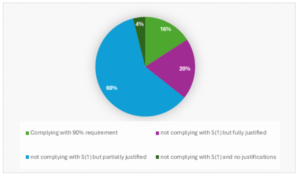
The compliance outcomes reveal several distinct compliance patterns beyond a simple compliant or non-compliant assessment. Out of the verified pool, 16% of operators complied with Article 5(1) by meeting the 90% uplift requirement. 20% of operators did not meet the 90% threshold but were able to justify all non-tanked quantities. 60% of operators were only able to justify part of the non-tanked quantity reported, while 4% operators could not justify any non-tanked quantities at all.
This gives a more realistic picture of how ReFuelEU Aviation is working in practice. The verified numbers show that full compliance remains difficult for many operators, but it also shows that non-compliance does not always mean a weak case. In many instances, the issue is not the presence of non-tanked quantities itself, but whether those quantities are justified under “yearly tanked quantities for fuel safety rules” and are supported by accurate data tracking and supporting evidence.
The main message from this first layer of analysis is simple: compliance is not just about how much fuel was uplifted, but whether the operator can explain the difference when it falls short.
We also notice that the highest number of operators fall under the category of partially justified, implying that most operators had difficulties justifying all the non-tanked quantities they faced. That is where the quality of reporting starts to matter as much as the operational result itself.
One of the clearest patterns in the 2025 reporting year is that justification quality now separates the operators with manageable non-compliance from those with exposure. Operators with full justification were generally able to show that non-tanked quantities were linked to operational or safety-related considerations and that the supporting evidence was available and traceable. In those cases, the verification process was largely about confirming that the explanation matched the reported data. The more difficult cases were the partial justifications (where the operators were able to justify non-tanked quantities at a few airports but not all). These were the reports where some airports were supported by adequate evidence, but others were not. In various cases, they usually point to gaps in record-keeping or inconsistent data collection rather than a complete absence of an operational reason.
The smallest but most exposed group is the one that could not justify non-tanked quantities at all. In those cases, the report may still contain a reason for uplift behaviour, but without the evidence needed to support it, the outcome remains weak from a compliance standpoint.
This year of ReFuelEU Aviation reporting provides valuable insight into how aircraft operators are implementing and demonstrating compliance with the Regulation. While a proportion of operators met the Article 5(1) uplift requirement across all relevant Union airports, many relied on Article 5(2) justifications to account for non-tanked fuel quantities. The results highlight the importance of robust record-keeping, accurate fuel data, and well-documented supporting evidence in demonstrating compliance.