
Aviation & SAF
View this service

At Normec Verifavia (NV), we’re proud to be a trusted partner in aviation emissions verification. As one of the leading independent verifiers in the aviation sector, we work closely with aircraft operators to help them meet regulatory requirements under frameworks such as CORSIA, the EU Emissions Trading System (EU ETS), the UK ETS, and the Swiss ETS.
For the 2024 monitoring period, we verified a total of 45.7 million tonnes of CO₂ emissions reported by 139 operators under the EU ETS and UK ETS. A key development this year was the introduction of Article 53a of the Monitoring and Reporting Regulation (MRR) under the EU ETS, aiming for more precise attribution of emissions reductions from Sustainable Aviation Fuel (SAF) use. Most of the SAF claimed under the EU ETS came from used cooking oil (UCO) and animal fat, while in the UK ETS, UCO was the sole feedstock. This continued reliance on waste-based SAF highlights both the maturity and growing importance of sustainable fuels in aviation’s decarbonisation journey.
Before we dive into this newsletter article, let us have a quick recap on what the EU ETS and the UK ETS are and the role of a SAF claim. The EU ETS and UK ETS are cornerstone market-based mechanisms implemented to cap and reduce greenhouse gas emissions across various industries, including aviation. Independent verification bodies like Normec Verifavia (NV) ensure that all reported emissions and SAF claims comply with regulations, safeguarding the systems’ credibility. The idea behind a SAF claim is pretty simple but important it allows aircraft operators to account for the use of alternative fuels by reducing their annual emissions accordingly. Since SAF produces lower greenhouse gas emissions over its lifecycle compared to conventional jet fuel, operators can deduct these as zero-rated emissions, provided specific sustainability criteria are met. This encourages aircraft operators to keep investing in greener fuels, helping aviation take a meaningful step toward reducing its carbon footprint.

Total emissions reduction (tCO2)107139Total Emissions verified by NV1097914
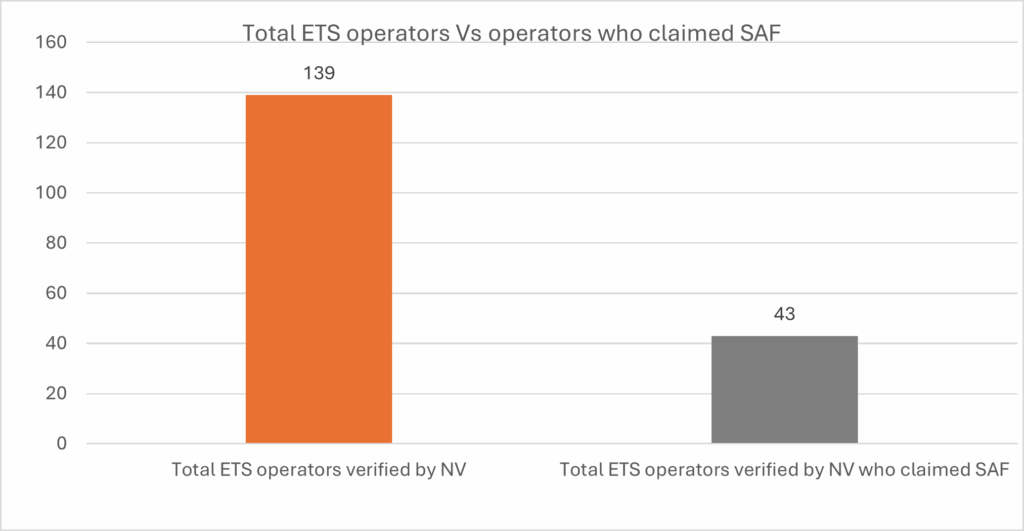
As mentioned earlier, Normec Verifavia has verified around 46 million tCO₂ of reported emissions for 139 operators. Among these, 43 operators claimed emissions reductions from the use of SAF. As shown in the chart above, these verified SAF reduction claims represent a small fraction of the total verified emissions. Our recent analysis has unveiled some interesting insights about these SAF claims read on to learn more.
To better understand how SAF usage translates into verified emissions reductions, it’s important to grasp the role of the new requirements established in 2024 by the EU Commission in the revised MRR and their implications for the reporting procedures. One of these is the introduction of Article 53a, which sets the rules for reporting the use of alternative aviation fuels under the EU ETS. This article is designed to ensure that aircraft operators accurately attribute their SAF use to their flights, reflecting the real environmental benefit in their emissions reporting.
A key aspect introduced by this article is the proportionality factor, which comes into play when SAF cannot be physically linked to a specific flight, that is, when the fuel is distributed through pipelines rather than delivered in identifiable batches. In these cases, operators must allocate SAF usage proportionally to their flights based on the ratio of emissions from flights covered by the EU ETS’s reduced scope departing from the aerodrome where the SAF was supplied. Simply put, the factor compares emissions from flights covered under the EU ETS reduced scope departing from that airport, with total emissions from all flights departing from there, including those outside the reduced scope.
This means that if a large share of an operator’s emissions from flights departing from an aerodrome that fall outside the reduced scope, their proportionality factor and thus the amount of SAF they can claim, is reduced accordingly. As a result, many operators are unable to claim 100% of the SAF they used at certain aerodromes, given that the proportionality factor adjusts the claim to reflect the actual share of emissions covered by the scheme.
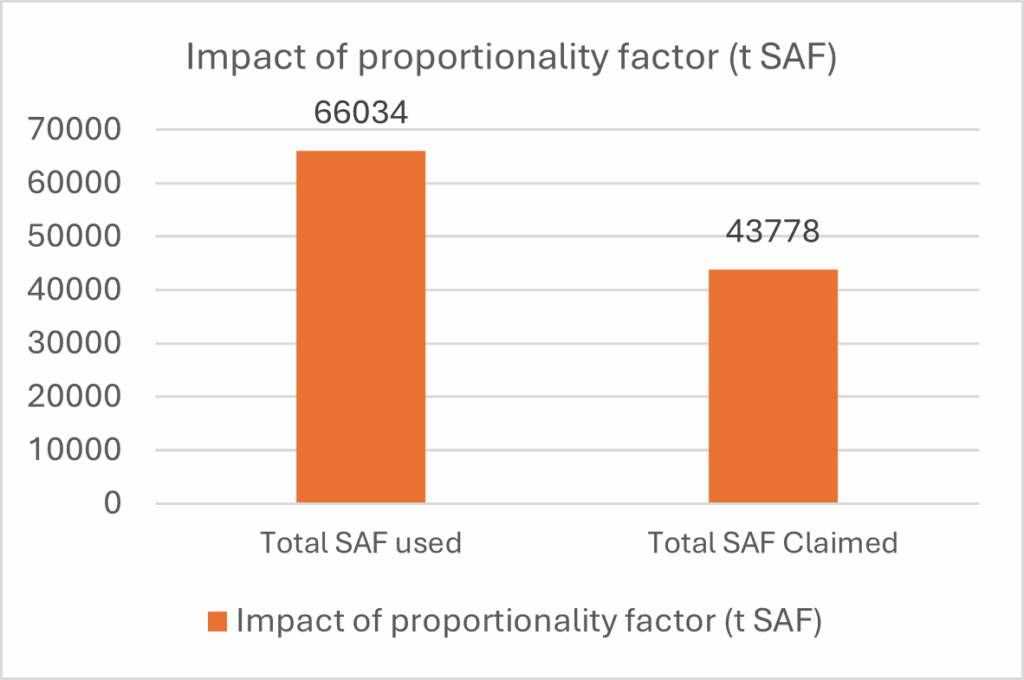
After reviewing the verified data for 2024, our analysis shows that while operators used a total of 66 034 tonnes of SAF under the EU ETS, only approximately 43 778 tonnes could be claimed after applying the proportionality rule. This represents roughly a 34% reduction in SAF claims due to this proportional attribution. However, while this regulatory requirement may seem to limit SAF claims, it plays an important role in ensuring fair and accurate reporting by preventing over-claiming where SAF cannot be directly tied to specific flights. Operators must also provide evidence that the SAF was delivered to the airport fuelling system within the reporting period (or up to three months before or after) to support these claims.
The proportionality factor thus maintains the integrity of emissions reporting and helps build confidence in the environmental benefits being claimed. Understanding this balance between challenge and fairness is essential as the aviation industry continues its journey toward sustainable fuels. By applying this proportional attribution, aircraft operators ensure that SAF claims are both accurate and fair, reflecting actual fuel use at each aerodrome and reinforcing the credibility of emissions reporting under the EU ETS.
We have discussed how regulatory compliance has posed challenges for aircraft operators when claiming SAF. Now, let’s shift focus to the technical side of SAF by looking at the different feedstocks used in 2024 and their importance in advancing sustainable aviation.
In 2024, a variety of feedstocks were used to produce SAF supplied to aircraft operators under the EU ETS and UK ETS schemes. These feedstocks play a crucial role in the environmental performance of SAF and its potential to reduce aviation emissions. The most commonly used feedstock was used cooking oil (UCO), followed by animal fat, carinata, and tallow.

In 2024, SAF claims under the EU ETS and UK ETS were supported by a total of 76,947 tonnes of feedstock, with the EU ETS accounting for 43,778 tonnes and the UK ETS for 33,169 tonnes.
Overall, approximately 76 947 tonnes of feedstock were used to produce SAF claimed in 2024, with 43 778 tonnes attributed to claims under the EU ETS and 33 169 tonnes under the UK ETS. The breakdown is as follows:
Under the EU ETS:
Under the UK ETS:
These feedstocks reflect the types of sustainable materials currently available and compliant under EU and UK regulations. Waste-based feedstocks such as UCO are widely used because they offer significant greenhouse gas savings and meet strict sustainability criteria. While aircraft operators do not produce SAF themselves, they contract suppliers who provide fuels based on availability and regulatory compliance. The predominance of UCO in the reported feedstocks highlights both market availability and regulatory acceptance.
By understanding the different feedstocks used, we gain insight into the technical foundation of SAF and the practical realities of sourcing sustainable fuels within the aviation industry.
At Normec Verifavia, we’re proud to play a key role in helping the aviation industry move toward a cleaner future by making sure emissions reports are accurate and trustworthy. In 2024, we verified 43 aircraft operators claiming SAF use, and that number keeps growing year after year. Most SAF used comes from tried-and-true feedstocks like used cooking oil, which remains the backbone of sustainable aviation fuels today. That said, exploring other feedstocks will be important to build a more diverse and resilient supply as the market continues to evolve.
A big part of this year’s story is the introduction of new rules for SAF reporting in the MRR, such as Article 53a. While this has led to a reduction in the amount of SAF that can be claimed, about a third less than the total SAF used, it’s an important step to keep the reporting fair, transparent, and credible.
As regulations tighten and the landscape of sustainable aviation fuels evolves, Normec Verifavia remains committed to supporting the industry with trusted verification services and insightful analyses, helping aircraft operators navigate complexities while advancing toward a greener future.