
Carbon Offsetting and Reduction Scheme for International Aviation (CORSIA)
View this service
CORSIA, adopted in 2016, sets a global system to monitor, report, verify, and offset international aviation emissions above 2019 baseline emissions levels. Now in its first phase, aeroplane operators may face offsetting obligations for the first time. The 2024 Sectoral Growth Factor (SGF), to be released in October 2025, is expected to be positive. States will inform each operator of its offsetting requirements by 30 November of the following year (e.g., 2024 obligations in 2025, 2025 in 2026, and so on). On 30 November 2027, States will also inform operators of the requirement for 2026 as well as the final obligation for the 2024–2026 compliance cycle.
Operators can purchase and cancel eligible emissions units at any point during the compliance cycle but must ensure that all final obligations are met by 31 January 2028, or within 60 days of notification. These obligations can be reduced through the use of CORSIA Eligible Fuels (CEFs), provided claims are fully documented.
The Sectoral Growth Factor (SGF) is one of the cornerstones of CORSIA. It represents the rate of growth of international aviation CO₂ emissions above the 2019 baseline and is applied uniformly across all participating operators.
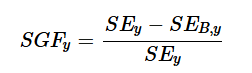
Where:
SEy = Total sectoral CO₂ emissions for State pairs subject to offsetting requirements in the given year y
SEB,y = 85 per cent of total annual sectoral CO₂ emissions for State pairs subject to offsetting requirements in 2019 in the given year y.
Each operator’s offsetting requirement = Operator’s offsetting emissions × SGF.
The SGF ensures that offsetting obligations are linked to collective sector growth, promoting fairness and competitive neutrality. By applying the same growth factor to all operators, CORSIA avoids penalising individual airlines for traffic patterns, market share, or regional differences in growth.
The 2024 SGF will be published in October 2025, and based on traffic projections, it is anticipated to be positive, indicating that overall sector emissions have surpassed the 2019 baseline emissions levels. This outcome carries direct impact:
The SGF thus acts as the trigger mechanism in CORSIA, transforming sector-level emissions data into enforceable offsetting obligations for individual operators.
The official CORSIA Annual Sector’s Growth Factor (SGF) document will be published on the ICAO CORSIA website under the CORSIA Central Registry (CCR), ensuring transparency and equal access to the data for all stakeholders.
CORSIA Eligible Fuels (CEFs) are aviation fuels that deliver lifecycle GHG reductions compared to fossil jet fuel and comply with ICAO’s sustainability requirements. They can be used to reduce the total offsetting obligation of an operator for a compliance cycle, and include Sustainable Aviation Fuels (SAFs) and Lower Carbon Aviation Fuels (LCAFs).
Produced from renewable feedstocks such as waste oils, agricultural residues, or advanced bio-materials, SAFs must:
Unlike SAFs, LCAFs are derived from fossil sources but deliver lower lifecycle emissions due to improved production methods, carbon capture, or cleaner hydrogen use in refining. LCAFs are recognised as CORSIA Eligible Fuels when they meet ICAO lifecycle and sustainability requirements.
To reduce offsetting obligations, operators must provide:
Verification ensures claims are robust and prevent double-counting, strengthening transparency and credibility.
When reductions from CEFs and operational measures are not enough to cover offsetting requirements, operators turn to Eligible Emissions Units (EEUs).
The approval of EEUs is grounded in the CORSIA Emissions Unit Eligibility Criteria. These criteria ensure both environmental and social integrity and consist of two key layers:
TAB undertakes assessments at the programme level, and only those programmes that meet the criteria are recommended to the Council for approval. Emissions Unit Programmes are approved by the ICAO Council to supply CORSIA Eligible Emissions Units. While several programmes were approved in the Pilot Phase, not all continue into the First Phase (2024–2026). Operators must therefore ensure that units are sourced only from ICAO-approved programmes for the relevant compliance period.
Under CORSIA, each aeroplane operator must meet its offsetting requirement (as calculated and formally communicated by its State) by cancelling a quantity of CORSIA Eligible Emissions Units equal to its final obligation for that compliance period.
EUCR (Emissions Unit Cancellation Report): After cancellation, operators must prepare and submit an EUCR.
This process ensures that operators’ obligations are not only fulfilled but also independently verified, maintaining the integrity and credibility of the scheme.
While the SGF, CEFs, and EEUs form CORSIA’s technical foundations, its credibility relies on independent verification.
As a trusted third-party verifier, Normec Verifavia ensures:
This independent oversight gives regulators, customers, and investors confidence in operators’ compliance.
The 2024 Sectoral Growth Factor (SGF), due in October 2025, is expected to be positive, triggering offsetting obligations under CORSIA. States will confirm these by 30 November 2025, with operators required to purchase and cancel Emissions Units within the compliance period, or by its close, supported by verified EUCRs. Obligations can be reduced through CORSIA Eligible Fuels, provided claims are fully documented and verified. At Normec Verifavia, we ensure operators not only meet compliance requirements but also showcase real progress on aviation’s journey to net zero.