
SEEMP Part II & III Verification
View this service
The International Maritime Organization (IMO) has strengthened the regulatory framework for fuel consumption monitoring and energy efficiency with the adoption of Resolution MEPC.395(82) on 4 October 2024. This resolution introduces the 2024 Guidelines for the Development of a Ship Energy Efficiency Management Plan, officially revoking the earlier 2022 framework. SEEMP Part II remains a mandatory component under MARPOL Annex VI Regulation 26.2, with updated guidelines enhancing transparency, consistency, and verifiability of operational reporting.
Ships of 5,000 gross tonnage and above must now report more detailed (with extra granularity) annual fuel consumption data, including fuel type, fuel use by emission source, power demand at berth, and Transport Work. These updates reflect the IMO’s commitment to operational accuracy and decarbonization (broader strategy to reduce greenhouse gas emissions from international shipping).
The evolution of SEEMP II is significant. Under the previous MEPC.346(78) framework, the Carbon Intensity Indicator (CII) and SEEMP Part III were introduced, anticipating future SEEMP II restructuring. MEPC.395(82) completes this transition by standardizing the SEEMP II format and expanding reporting requirements. Key additions include mandatory cargo reporting for Transport Work, fuel consumption by machinery type, event-based voyage reporting (BOSP, EOSP, FAOP), and power tracking at berth.
MEPC 83 revisions require event-based reporting, replacing the older noon-only entry system. The key event tags are:
For short voyages without a distinct sea passage, berth-to-berth reporting applies. Noon-only reporting is no longer acceptable, ensuring accurate capture of operational boundaries and fuel consumption.
| Aspect | Old SEEMP II Format (MEPC.346(78)) | New SEEMP II Format (MEPC.395(82)) |
|---|---|---|
| Transport Work | Not mandatory | Cargo reporting is mandatory to calculate Transport Work |
| Power at Berth | Not mandatory | Mandatory (includes average power & shore power usage) |
| Distance Travelled | Laden distance reporting not mandatory | Laden distance must be calculated when the vessel is loaded |
| Fuel Oil Consumption per Consumer Type | Not mandatory | Fuel consumption mandatory per fuel emission sources (ME, AE, Boilers, etc.) |
| Fuel Consumption Monitoring Method for each emission source | Not mandatory | Methods for measurement for each emission source |
| Incinerator | Not mandatory | Must be included in the emission sources |
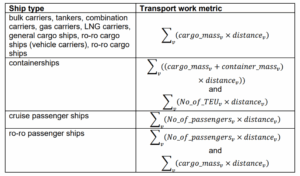
Total transport work is the annual sum of each voyage’s transport work, which is distance sailed multiplied by cargo carried during a voyage.
 Verified SEEMP II documents enable flag administrations to issue the required Confirmation of Compliance. Normec Verifavia ensures operators meet the regulatory requirements accurately and efficiently, supporting environmental accountability and operational transparency across the fleet.
The required CII for the next three years, calculated according to the vessel’s particulars. The target CII for the next three years, based on planned operational measures. An implementation plan detailing how the required CII will be achieved over the three-year period. Procedures for self-evaluation and continuous improvement. A Corrective Action Plan, if applicable, in case of a “E” CII rating.
All ships with an approved SEEMP Part III (Ship Operational Carbon Intensity Plan) must revise the document to include an implementation plan showing how the required CII will be achieved for the period 2026–2028. This update is in line with the Guidelines for the Verification and Company Audits by the Administration of Part III of the SEEMP (MEPC.347(78)).
Ship operators should prepare updated SEEMP II documents starting 1 August 2025, with submissions accepted until 31 December 2025. The revised SEEMP II must be onboard and effective by 1 January 2026, which is also the start of CII monitoring under the updated.
A SEEMP Part III should be revised (before the end of the last year in the Three-year implementation plan) and re-verified every three years (e.g. for a ship delivered prior to 1January 2023, before 2026 for 2026-2028 period, before 2029 for 2029-2031 period).
Normec Verifavia SAS is well-positioned to guide shipowners and operators through this regulatory transition by offering expert verification, technical assessments, and ongoing compliance support. Our end-to-end services ensure that SEEMP II & III documents are not only compliant but also strategically aligned with long-term sustainability and operational efficiency objectives. We remain committed to supporting the maritime industry in achieving environmental compliance with confidence and clarity.