
European Union Emissions Trading System (EU ETS)
View this service

The UK ETS operates on an entirely digital administrative model.
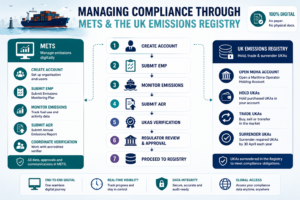
In a significant departure from international maritime traditions, the UK ETS does not issue a physical, paper Document of Compliance (DoC) to be kept on board ships. Instead, a fleet’s entire compliance history is tracked and managed digitally across two unified web platforms:
Shipping companies cannot select their regulator. Every operator is assigned a specific competent UK national authority based on corporate geography:
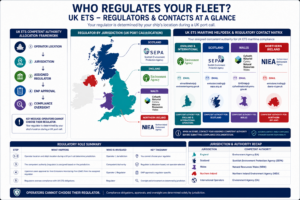
Operators must use these official channels to execute account setups and manage monitoring plan approvals:
| National Jurisdiction | Competent Regulatory Authority | Official Maritime Helpdesk Email |
|---|---|---|
| England & International | Environment Agency (EA) | [email protected] |
| Scotland | Scottish Environment Protection Agency (SEPA) | [email protected] |
| Wales | Natural Resources Wales (NRW) | [email protected] |
| Northern Ireland | Northern Ireland Environment Agency (NIEA) | [email protected] |
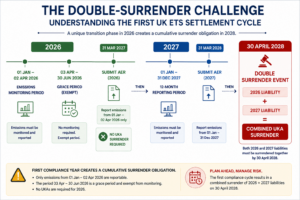
To avoid non-compliance, maritime operators must transition into a rigorous corporate data management cycle.
To protect operators from immediate cash flow strains while onboarding, the UK Authority has decoupled the first annual data reporting deadlines from the actual allowance surrender deadlines:
Operating within the UK ETS transforms carbon emissions into a direct, volatile corporate balance-sheet liability.
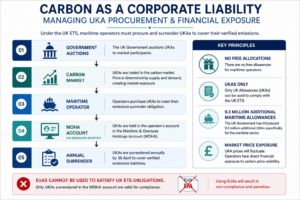
To integrate the shipping sector, the UK Government is injecting 9323546 total allowances into the general UK ETS cap for Phase I (running through 2030). This volume is strictly aligned with the UK’s Maritime Decarbonisation Strategy net-zero pathway.
Strict Market Separation Warning: Operators cannot surrender EU Allowances (EUAs) to cover a UK ETS debt. Sourcing an EUA for a British compliance obligation is legally invalid and will leave the company fully exposed to structural non-compliance penalties.
Compliance with the UK Emissions Trading Scheme (UK ETS) is not limited to monitoring and reporting emissions. Operators must also surrender the required number of UK Allowances (UKAs) corresponding to their verified emissions. Failure to do so can result in significant financial penalties and ongoing compliance obligations. The penalties for failing to purchase and surrender sufficient UKAs by the annual 30 April deadline are immediate and severe:
Even after the penalty has been paid:
Failure to comply with UK ETS obligations may lead to consequences beyond the direct monetary penalty, including:
Operators should therefore view allowance surrender as a core compliance requirement rather than simply a financial obligation.
Given the commercial impact of UK ETS compliance, shipowners and charterers should clearly define:
Clear contractual arrangements help minimise disputes and provide certainty regarding financial responsibility.
Industry-standard clauses developed by BIMCO can assist parties in allocating UK ETS-related responsibilities and costs.
These clauses can address matters such as:
The use of well-drafted contractual provisions can significantly reduce the risk of disagreements and unexpected financial exposure.
Unlike initial industry proposals, the UK Government has firmly stated it will not provide a legislative mandate for cost recovery or carbon cost pass-through to time-charterers. The state expects commercial parties to resolve carbon asset positioning through standard contract law.
Because operational decisions (speed, route, and cargo) are typically determined by commercial charterers, ship managers and owners must proactively integrate standardized carbon clauses such as BIMCO ETS allocation clauses directly into charter party agreements to ensure seamless commercial pass-through.