Building Trust: Independent Emissions Verifier

FuelEU Maritime

FuelEU Maritime 

FuelEU Maritime effective from 1 January 2025, is part of the EU Fit for 55 package. It caps the annual GHG intensity across the well-to-wake cycle of the ships operating in the EU & EEA, promoting renewable & low-carbon fuels to meet 2050 targets of climate neutrality. Normec Verifavia provides independent verification of GHG intensity, compliance balance, FuelEU penalty, pooling mechanism, guiding shipowners to smart FuelEU compliance.

Scope of Application: 

FuelEU Maritime applies to all vessels over 5,000 GT, regardless of flag, engaged in passenger or cargo transport calling at EU and EEA ports. Coverage includes the EU27, EEA states, and EU Outermost Regions (Azores, Canary Islands, French Guiana, Guadeloupe, La Réunion, Madeira, Martinique, Mayotte, Saint Martin).
Exempted vessels: Warships, naval auxiliaries, fishing and processing vessels, wooden ships of primitive design, non-mechanically propelled ships, and government vessels. 

Illustrative note: Norway & Iceland:
FuelEU is not yet fully integrated into the EEA Agreement. Until then:

  • Their ports are treated as third-country ports.
  • Voyages between EU ports and Norwegian/Icelandic ports: 50% of energy use counts under FuelEU.
  • Voyages within Norway, within Iceland, or between the two (including port stays) are fully exempt.

Why Choose Normec Verifavia?

  1. Digital Integration: Automation and API-based systems enable accurate, streamlined reporting and reduce errors in both ship-level and company-level submissions.  
  2. Efficient and Reliable: Our structured verification process ensures timely completion, reducing administrative workload while maintaining compliance with strict deadlines.  
  3. Objective Expertise: As an independent verifier, we deliver unbiased assessments supported by transparent methodologies and regulatory alignment.  
  4. Credibility and Trust: Verified data from Normec Verifavia strengthens stakeholder confidence and demonstrates accountability in environmental compliance. 
  5. Established verification programme: For the FuelEU, we have established a Verification Program (reference: FuelEU Verification Program v.1 – May 2026), which is shared with our clients prior to the engagement phase.

FuelEU Maritime: Key Features and Requirements 

FuelEU Maritime aims to cut shipping emissions by driving the shift to renewable and low-carbon fuels through two main measures: 

  • GHG intensity caps on fuels used by ships calling at EU/EEA ports. 
  • Mandatory On-shore Power Supply (OPS) / zero-emission tech at berth in EU/EEA ports for container and passenger ships (from 2030). 

Key Measures of the Regulation 

FuelEU Maritime is designed to increase the share of renewable and low-carbon fuels in shipping by setting binding limits and obligations.  

  • GHG Intensity Caps: Sets emission limits per unit of energy, promoting cleaner fuels.
  • OPS & Zero-Emission Tech: From 2030, container and passenger ships at EU ports must use OPS or zero-emission alternatives while berthed.
  • Renewable Fuels & Incentives: Supports biofuels, ammonia, hydrogen, and RFNBOs (e-fuels).
    • If RFNBOs <1% of maritime energy by 2031 → 2% mandatory subtarget from 2034. 
    • RFNBOs enjoy a 50% GHG reduction factor in compliance calculations.

GHG intensity limit used on-board by the ships 

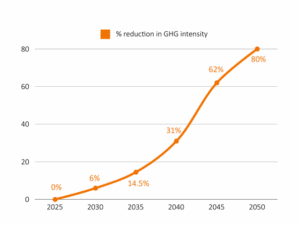
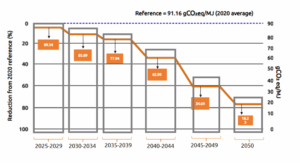
The FuelEU Maritime regulation has set an energy usage limit for ships on board, with a reference value of 91.16 & target value pf 89.34 grams of CO2 equivalent per megajoule (MJ). This reference value is set to undergo periodic reductions – set in 5-year steps, ranging from 2% in 2025 to 80% in 2050.   

Wind assisted Propulsion is incentivized through a reward factor given in function of installed Wind Power ranging from 0.95 to 0.99  

Reward factor (Fwind) Pwind / Pprop
0.99 0.05
0.97 0.1
0.95 ≥0.15

Flexibility Mechanisms: Pooling, Banking, and Borrowing  

FuelEU Maritime provides mechanisms to support ship operators manage compliance effectively:  

  • Pooling: Ships even across different companies can pool compliance balances. The surplus from one vessel offset shortfalls in another, improving fleet-wide flexibility.
  • Banking: Operators can carry forward surplus compliance balances to future periods rewarding efficient ships and strengthening long-term compliance strategy. 
  • Borrowing: Ships can borrow compliance credits from the future period to meet current regulation providing a temporary solution to maintain compliance during underperformance, with the obligation to balance in later years. 

Pooling comes with very concrete rules, as detailed in Article 21 of the Regulation –  

  • Register pooling intention in the FuelEU database. 
  • A ship can join only one pool per reporting period. 
  • Pools must show an overall compliance surplus. 
  • Verifier selection and pool details must be validated by all participants. 
  • Applies to all ships in scope, regardless of type or size.

RFNBO Subtarget and Incentives

FuelEU Maritime promotes the use of Renewable Fuels of Non-Biological Origin (RFNBOs), such as e-diesel, e-methanol, e-LNG, e-hydrogen, e-ammonia, e-LPG, and e-DME. 

  • Subtarget: If RFNBOs make up less than 1% of maritime energy use by 2031, a mandatory 2% target will apply from 2034 to drive adoption.
  • Incentives: RFNBOs benefit from a 50% GHG intensity reduction factor, making them more attractive for compliance and emissions reduction. 

FuelEU Maritime: Derogations 

  • Ice-Class Ships (until 31 Dec 2034):
    Operators may exclude extra energy use from sailing in ice, if vessels hold ice class IC, IB, IA, IA Super (or equivalent).

    • IA & IA Super: based on technical characteristics.
    • All ice-class ships: when sailing in ice regions. 
  • Container Transshipment Ports:
    Ports within 300 nautical miles of a neighboring transshipment port are excluded from the “port of call” definition. 
  • Small Islands Exemption:
    Temporary exemption from emission allowances for passenger ships (except cruises) and ro-pax ferries serving domestic routes between small islands and the mainland. 

    • Eligible islands: no road/rail link + <200,000 residents. 
  • Transnational Public Service Obligations (PSO):
    Passenger ships and ro-pax ferries on qualifying transnational PSO routes are exempt from allowances. 

    • Applies when linking a land-borderless Member State to its nearest EU neighbor. 
    • Example: Cyprus–Greece route (formally recognized). 

Fuel Prioritization / Redistribution in FuelEU 

Fuel prioritization / redistribution in FuelEU Maritime = a compliance calculation rule that assigns lower-GHG fuels priority in the energy mix accounting, ensuring they reduce the vessel’s overall reported GHG intensity more effectively than under a strict averaging method. This is an essential functionality to ensure the lowest possible GHG Intensity of a vessel and is automatically implemented on THETIS.

Date Action
By 31 August 2024 Submit Monitoring Plan to Verifier
From 1 January 2025 Start monitoring according to the approved monitoring plan
By 31 January 2026 Submit FuelEU report to verifier
By 31 March 2026 and each year onwards The verified FuelEU report shall be recorded in the FuelEU database by the Verifier which includes average GHG intensity, compliance balance
By 30 April 2026 and each year onwards The company shall record the advance compliance surplus, following approval by its verifier, in the FuelEU database.
The verifier should record the use of a pool in the compliance database.
By 30 June 2026 and each year onwards Payment of possible remedial penalties to Administering Authority and issue of DoC (Verifier to issue DoC in case no remedial penalties)

Interested in learning more about FuelEU Maritime?

Gain exclusive access to our recorded FuelEU Maritime webinar session held on 9th April 2025.

Complete the form below to receive temporary access to the webinar recording for a period of one week.

Name(Required)

Wonder what we can do for you?

Contact us
Process
  1. Preparation & submission of FuelEU Monitoring Plan

    Prepare Submit a Monitoring Plan (MP) for each ship to the verifier. For first-time calls to EU ports after this date, the MP must be submitted within two months of calling/port of call at the EU port. Record details on power demand at berth, OPS, ZET, wind-assisted propulsion, SSE, etc. Submit to your Verifier by 31 August, 2024. 

  2. Start monitoring

    Record and report daily data to the Verifier as per the approved Monitoring Plan from 1 January, 2025 onwards. 

  3. FuelEU Report Submission

    Submit the ship-specific FuelEU Maritime report to the verifier on THETIS by 31 January 2026 

  4. Flexibility Mechanism Selection (by 30 April 2026)

    Verified reports are logged in the FuelEU database by 31 March. Compliance surplus and pool participation must be recorded in the FuelEU database. Based on compliance balance, choose flexibility options:

    • Positive: pooling or banking 
    • Negative: pooling or borrowing

    Inform the Verifier and get their approval. 

  5. DOC on board

    The ship must hold a FuelEU Document of Compliance onboard, with penalties settled where applicable. 

Downloads

FAQ

Find answers to the most commonly asked questions

Does every vessel need to individually comply with FuelEU Maritime requirements?

No – Compliance is calculated at the company level, meaning you can balance performance across your fleet. Surpluses from one ship can offset shortfalls from another. 
How is GHG intensity actually calculated under FuelEU Maritime?

It’s based on well-to-wake emissions (fuel production, transport, and use), multiplied by energy consumed. The average intensity is then compared against annual tightening targets (from 2025). 

What is “fuel prioritization / redistribution” in FuelEU Maritime?

When multiple fuels are used, low-GHG fuels are prioritized in calculations. This maximizes their positive impact, lowering the GHG intensity. 

Can we trade or pool compliance with other companies?

Yes. FuelEU allows companies to form pooling agreements, combining vessel balances. A surplus from one company can offset deficits from another, lowering penalties. 

What practical steps can operators take today to prepare?

  • Track fuel consumption fleetwide. 
  • Explore certified biofuels. 
  • Futureproof newbuilds for methanol, ammonia, hydrogen, or wind-assisted propulsion. 
  • Consider pooling or redistributing strategies. 

Can a single vessel be engaged in more than one flexibility mechanism at the same time?

Each vessel can only participate in one pooling arrangement per compliance period.  

  • Positive balance ships: A positive compliance balance vessel can either pool or bank (or both).
  • Negative balance ships: A negative compliance balance vessel may pool or borrow, but not both. Borrowing requires 10% of credits the following year. 

What if a ship was sold mid-year to another operator?

  • The selling company must file a partial emissions report on THETIS up to the sale date. 
  • The buyer assumes compliance responsibility for the rest of the year, including any borrowed credits. 
  • Past compliance balances are settled privately between the buyer and seller company. The penalty payment responsibility remains with the company in charge at the end of the year/ reporting period.